We earn a commission from third-party booking links, at no extra cost to you
[NOINDEX]
Methane Gas & Bermuda Triangle
The possible role of Methane Gas in Bermuda Triangle causing ships to sink came out in public in 1981 for the first time when a Geochemist Richard McIver explained a connection between the two. He mentioned that natural methane gas forming out of decomposed organic debris can get trapped inside Methane hydrates in the sediments deep below the ocean floor and in a highly concentrated form.
These hydrates although found mostly in permafrost areas (i.e. under the soil layer at a sub zero temperature and usually in polar regions), also exist in large quantities in the deep seafloors thousands of feet below the ocean. In fact the temperature and pressure conditions below such seabed are often conducive enough for the formation of the Methane hydrates which exist in form of icy crystals. This firm layer of hydrates also act like shield or a 'cap' on vast quantity of natural Methane gas which too exist below them and prevent them from getting released.
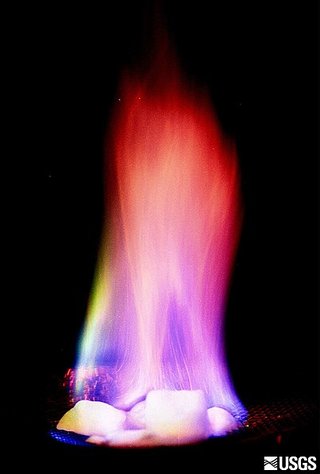
Burning Methane Hydrates
Released by USGS
Source: Wikimedia Commons
Richard shared that due to landslides within the seafloor, these hydrates can break and release enormous amount of Methane gas, not just from within the hydrates alone, but also from the vast natural storage of Methane gas in the layers below which were otherwise capped by the hydrates.
If such gas is released in enormous quantities, they can create a huge surge within the ocean and reach out to the water surface in no time. And a ship passing over the area can quickly sink because Methane can substantially reduce the density of water, and as a result lowers the required buoyancy that keeps the ship afloat. The vessel could then plunge into the depths and eventually get covered by the sediments settling back on the seabed that erupted into the ocean by Methane release.
Now the question is, does the ocean floor in Bermuda Triangle actually have large massive storage of Methane hydrates and natural Methane gas? And if it does, has there been any such Methane eruption in Bermuda Triangle that actually sunk a ship?
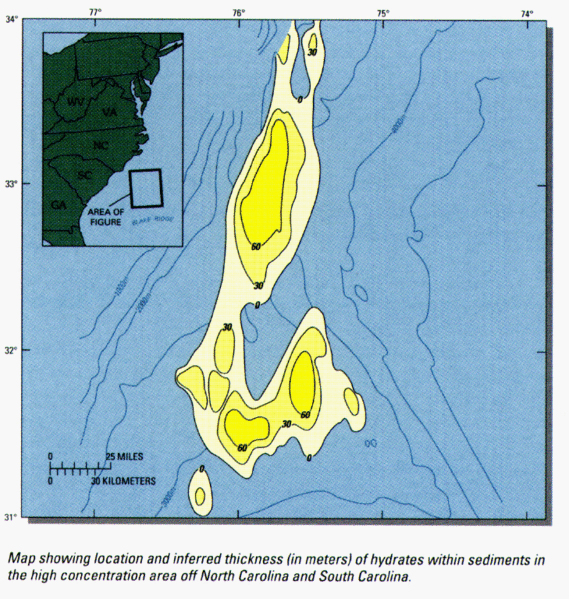
Publications from USGS (United States Geological Survey) shows that there are large deposits of undersea Methane hydrates in different parts of the world. One such area with large reserve of Methane hydrates is Blake Plateau which lies off the south-eastern coast of the US and between the US Continental Shelf and the Deep Ocean Basin.
Blake Plateau is considered part of Bermuda Triangle and extending up to 90 miles from east to west and 106 miles north to south with a depth of about 1,640ft. The plateau has been named after the ship George S. Blake (the U.S. Coast and Geodetic Survey steamer) that pioneered the exploration of deep ocean and Gulf Stream.
According to USGS, there has been no large Methane eruption in the Bermuda Triangle area in the past 15,000 years.
Large amount of Methane hydrates found by
USGS off the coast of North and South Carolina
Source: Wikimedia Commons
A study published in American Journal of Physics in 2003 (experiment carried out in a Laboratory in Monash University in Melbourne, Australia) demonstrated that, when a large bubble is created below the water surface and a model hull of a ship is placed over that, the hull sinks due to loss of buoyancy.
A similar theory had been extended to the ships passing through Bermuda Triangle. The Methane hydrates usually remain in solidified form below the seafloor. However if they break for some reason, large bubbles can form that rise up to the surface, and ships passing over the bubble could sink into the depths. And any wreckage that rises to the surface would be swept away by the Gulf Stream.
Although this theory worked well with the laboratory experiment, there is no evidence that such phenomena has ever taken place in Bermuda Triangle and with a real ship.
In several articles it has been mentioned that even planes flying over the ocean area where Methane blowout takes place can get destroyed. Being lighter than air, methane once having reached the ocean surface out of a surge, would continue to rise above the surface and can come in contact with a plane. Two things can hypothetically happen in such a case...
If the methane is in concentrated form and engulfs the engine, then it could choke the engine by cutting off the oxygen. In a lighter form, methane is highly combustible and can cause an explosion if it comes into contact with the hot engine exhaust. Debris would sink quickly because the density of the water below would be low due to the methane eruption.
This theory too is only a hypothetical one because there is no evidence to such incidents ever taking place in Bermuda Triangle, or for that matter anywhere in the world.
In July 2014, three large craters have been discovered in Siberia - one in Taymyr peninsula and two in Yamal Peninsula. One of the craters had a diameter of about 15 meters. The scientists and researchers of Trofimuk Institute of Petroleum Gas Geology and Geophysics in Russia tend to believe that these craters have been caused by huge underground explosion which took place as a result of large methane hydrate gas release, because the bottom of the craters had a high concentration of Methane gas. Some scientists suggested that similar phenomena of sinkholes may be happening in Bermuda Triangle ocean area as well where a ship could sink into the depths.
As before, no evidence of any such sinkholes were found in Bermuda Triangle to date.
Methane hydrates are however a vast storehouse of energy in form of Methane gas. They have a large potential to replace the conventional energy of fuel. The USGS has stated that the methane hydrates in the areas off the coast of South and North Carolina alone would be equivalent to 70 times the amount of gas annually consumed by the whole of US. So several countries have plans to drill into the layers of Methane hydrates in permafrost areas as well as deep into the ocean floors to make use of this energy in future.
However, being a greenhouse gas, the scientists are aware of the hazard it possesses should the drilling go wrong. Being very unstable beyond a narrow range of required pressure and temperature, a wrong drilling can potentially meet with a consequence of a hazardous blowout.
About the Author
 By Raj Bhattacharya
Raj has been writing about Bermuda since 2008, when he launched bermuda-attractions.com, one of the longest-standing independent guides to the island. A Certified Bermuda Specialist (Bermuda Tourism Authority), his work draws on personal visits, local contacts in Bermuda, and questions and trip reports from thousands of readers over the years.
Learn more about Raj Bhattacharya
Related Articles
|
Your Reviews
NOTE: I manually evaluate all posts and include only the ones that are original (not copy pasted from other sources) and having some serious matter.
George Boyce
There has been lab experiments showing that bubbles rising from Methane hydrates can quickly drown sample floating objects because the density of water diminishes significantly resulting in low buoyancy. The eruptions from Methane hydrates can also produce frothy waters that are much lighter in density.
The United States Geological Survey has stated that there is actually large underwater storage of such Methane hydrates worldwide. However, many research work have gone on to record that no such gas release has taken place in large enough quantities in the recent past causing ships or airplanes to sink in Bermuda Triangle.
Richard Miller
Ships do cross paths with methane foam rising to the surface as the gas rises for long period of time because of the large amount of the gas in an eruption. Bermuda Triangle is only an area where there is a lot of marine and air travel with accidents and a LOT of embellishment, imagination laced with a lot fantasies. Low flying airplanes do get the effects of methane gas which is lighter than air and tends to rise. The gas can either starve the engine of oxygen or if the engine is very hot it may ignite the gas if it is dense enough. This usually happens at 500 meters or less.
|