Bermuda Island Insights
About Bermuda
Bermuda is an archipelago on the north Atlantic and comprises of 181 islands, islets and rocks. Some of the islands of Bermuda are so tiny that they are fit only for birds' nests. The total area including all these tiny islands is about 21 square miles. Only about 20 of these islands are inhabited and eight of the larger ones are joined by bridges and one causeway that form the mainland of Bermuda.
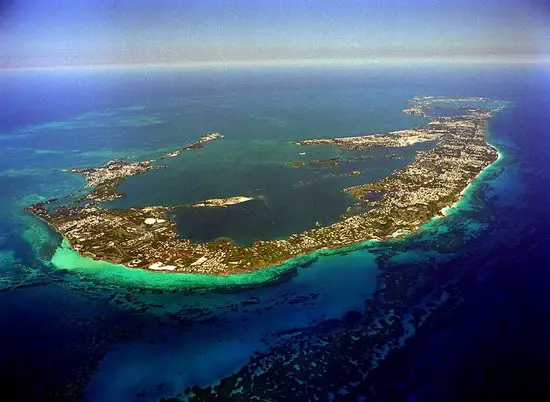
Bermuda Aerial View
Source: Wikimedia Commons
Bermuda is 21 miles long and at its widest point, it is 1.75 miles wide. Although Bermuda looks like a dot on a map, the shape of the island is like a fish hook, bending near south-west end and the stem extending towards north-east.
Bermuda is actually a volcanic rock created as a result of a volcanic eruption from the ocean floor some 100 million years back. From the sea floor up to 200 feet below the water surface, it's all volcanic rock. The remaining part of the island up to what you see above the surface is limestone rock that consists of seashells and corals. The highest point of Bermuda, called the Town Hill is about 76 meters (or 249 feet) above the sea level and is located in Smiths Parish.
The limestone rocks that formed the upper part of Bermuda islands have played an important part in the life of Bermudians. It's a rock that is naturally soft and can be easily cut with even saws. But it becomes hard with exposure to air. Bermudians have used this rock to create many white shiny roads in the island that are nothing but polished limestone.
Some mistake Bermuda to be a Caribbean island, it is not. It is a British Overseas Territory and administered independently as a country that is headed by the Premier. The resident population is around 65,000 and is a mix of whites mostly of British origin and blacks most of whose ancestry relate to African origin.
Bermuda is located off the US east coast and takes only 2 hours to reach by flight from New York. Several cruise lines operate regular cruise ships from New York, Boston, Baltimore etc to Bermuda during summer (May to October). A 7-day close-loop cruise between New York to Bermuda usually provides two and half days in the island and remaining days on the sea. While the island is sometimes referred in relation to the
infamous Bermuda Triangle, it is actually a
paradise on earth and quite safe.
Bermuda has
9 parishes or districts.
Hamilton City is the capital of Bermuda and located centrally in Pembroke parish. This is the hub of commercial establishments, numerous shops, restaurants and bars. The
Town of St. George is located at the eastern end (in St. George's parish) and close to the airport. It's a quaint laid-back town, a UNESCO World Heritage site and steeped with history. This is where the first settlement took place in Bermuda in 1609 and it became a British stronghold over time. And the
Royal Naval Dockyard located in Sandy's parish at the west end is the main cruise port of Bermuda with many historic and popular attractions of its own.
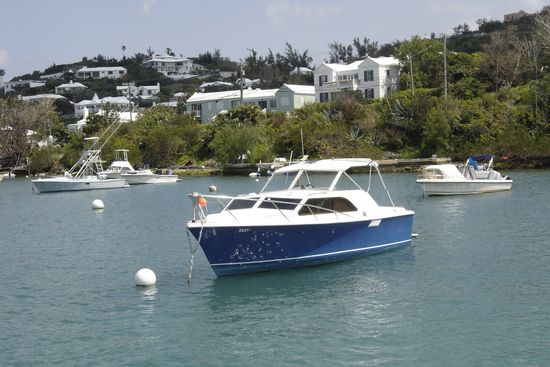
Boats on anchorage, Bermuda's Countryside
Bermuda follows Atlantic Standard Time (AST) which is 1 hour ahead of Eatsren Standard Time (as in the East Coast of the US). More about
Bermuda's Time Zone here...
Bermuda's Architecture
Bermudians also use this rock to build limestone roofs in their houses which then serve an important purpose. There are no fresh water lakes or rivers in Bermuda. All houses need to store the rain water in an underground reservoir and use it as drinking water. The rainwater passes through the grooves of the limestone roofs, gets purified and then stored in the tank where further filtering takes place.
The pastel color houses in pink, yellow, blue and other rainbow colors, along with their shiny white roofs, English gardens, and lush landscapes of Bermuda is a sight that you seldom find anywhere else. Most of Bermuda is still residential.
Traditional Houses and Buildings
Many houses in Bermuda and particularly in St. George reflect how the traditional private homes used to be in 17th to 19th centuries. You can see great features like gabled roof and hipped roof, fine chimneys some with dual flues, eaves, windows with wooden shutters, mouldings around the windows, pilasters, lovely gateposts, low boundary walls, wells and more. They are now mostly heritage houses and owned by Bermuda National Trust, some given out on lease as private residences.
History of Bermuda
Although Bermuda was first discovered in 1500s, it's actually the Englishman Sir George Somers and his sailors who first accidentally landed up in the island as their ship got wrecked. They initiated the first human settlement in the island. Bermuda went on to play a major role subsequently for the British as well as for the USA in both the World Wars and building strategic relationships between the two countries. But Bermuda's history has also been marked with slavery which took a long time to get eradicated.
People and Culture
There were many questions that started cluttering our mind. How did so many people come to such a remote and isolated island on the north Atlantic? What is their background and culture? How did they manage their living? What language do they speak, what do they eat and wear? And many more such questions. You will find all our findings to such questions in this section.
Traditions and Customs
There has been several external influences that made significant impact on the life style of Bermudians. Much of such influence have come from the British, the Americans and also the Caribbean and Portuguese. Such influences are reflected in the dress codes they follow, the accent in their language, the architecture of their houses, food and drinking habits, the belief system and lot more.
Legendary Bermudians
There have been several islanders who played key roles in shaping the island - be its economy, making a mark in the musical world, spreading love amongst the people, or positively influencing others and their lives by their sheer lifestyle and charisma. This section is a tribute to those Bermudians who remain close to the hearts of all islanders.
Events and Festivals
There are many periodic festivals and events taking place all across the island on almost every month of the year. Some of them are sporting events, while others are festive celebrations and events that reflect the deep culture and traditions of Bermuda.
Bermuda's Public Holidays
On public holidays, most commercial establishments in the island including shops, restaurants and offices remain closed. Even public transports like buses and ferries operate at a reduced frequency, and taxis will be hard to get. So, should you travel to Bermuda on a public Holiday? It's better you find out which are those days in the year before you travel and know what you may expect on those days.
Bermuda Shorts
What started as a comfort wear in early 1900s when the British Navy officers stationed in Bermuda visited the yacht clubs, gradually became a traditional formal wear. In fact, Bermuda Shorts is part of the island's national dress and is a formal business wear for men.
Although you will see many wearing colorful shorts as casual wears particularly in the beaches, you will also see men wearing the formal shorts with shoes and long socks, collared shirts, jacket and tie heading for their offices in the morning.
Music and Dance
The island over the years has created an amazing blend of music from all that it could gather from it neighbors like the Caribbean island Jamaica, and also from North America and United Kingdom. Today the Gombey dance and music, the steel pan, the Bagpipe and Calypso are all firmly integrated within the musical framework of the island. There have been many musicians of Bermuda who became forceful names in the world of music. And today the island has advanced to handle all the modern genres of music and dance.
Animal Life
While Bermuda may not be home to large exotic animals like the big cats, you will be surprised to know there are so many endemic species which are only unique to Bermuda and can not be found anywhere else in the world. Some examples include the Skink (Rock lizard), Bermuda's national bird the Cahow, Bermuda cave shrimps and lot more. And there are many other species as well. But how did all these creatures come to the island which is more than 600 miles from the nearest shore land? This section reveals all that.
Bird Life
Bermuda is a bird watchers' paradise. There are more than 200 species of birds that can be found in Bermuda. While there are many resident birds in the island, large numbers are migratory birds that migrate between the South and North America, and use Bermuda as a halting place. Know about the beautiful birds of Bermuda and the best way to go about bird watching in the island.
Plant Life and Vegetation
Among the vegetation, you will find plenty of cedars, palmettos, mangroves and other trees. Among the flowers, Easter Lilies in Bermuda are quite famous. They are exported and also used in making perfumes in Bermuda. Other flowers like hibiscus and oleanders are also quite common in the island
Fruits like bananas and vegetables like the tomatoes, sweet potatoes and onions are grown in plenty in the island. Know about the different species of trees and plants in Bermuda, including endemic trees and plantations which are unique to the island, and also the native and introduced species.
Update: Onions are no longer grown commercially in Bermuda for exports.
Bermudians are Onions?
It's a fact that Bermudians once took pride in calling themselves onions. There was a time when onions grown in Bermuda commanded high demand and price in the western world including in the USA, and that became the major trade in the island.
How tourism thrived in Bermuda
This small little island had to focus on tourism to keep pulling on with its economy. After all the thriving onion harvesting and trade that once helped Bermuda flourish, was quickly coming to an end by late 1800s. So it had to do something else. While wealthy tourists started trickling in as early as mid 1800s, it was only in early 1900s when Bermuda got serious with its tourism business.
International Business
While tourism thrived, it could not be the only force to propel Bermuda to the level of economy where it is today. And when it got the first opportunity, it invited the Shell Oil Company to set up its international business in 1947 even when there was no legislation in place to support such industry.
Today there are over 18,000 international companies (mostly in insurance and re-insurance sectors) and off shore businesses that are operating out of Bermuda. After all, Bermuda has offered a tax free haven to them who in turn help in the island's economy and offer employment to the Bermudians creating a win-win situation for both.
Bermuda's Economy
So tourism and international businesses became the two main pillars of Bermuda's economy, in fact the latter overshot the former. And Bermuda became one of such countries where the per capita income is one of the highest in the world.
Both industries offered plenty of jobs to the islanders. However the cost of living too became one of the highest since Bermuda has no produce of its own and had to import virtually everything. And being such a small island with land property at premium, the real estate prices too shot up.
More info...
Bermuda's Coral Reefs
The coral reefs around Bermuda are some of the northern most reefs that can be found in the Atlantic. These reefs formed by corals grow from the bottom of the ocean. While the corals grow on the surface and make the reefs look colorful and spectacular, the reefs are also home to amazing marine life and fish.
Shipwrecks of Bermuda
The treacherous and hidden coral reefs around Bermuda had been the cause of ill fate for many passing ships in the past when there was no good navigational system available. There are more than 300 shipwrecks that are lying in the waters of North Atlantic and close to Bermuda. Many of these ships were of great significance and had interesting stories about them and their wrecking.
Weather
Weather in the island is sub-tropical in nature. It is never too hot or too cold. The temperature varies between average high of 87°F during summer to a low of 56°F in winter. While there is plenty of rainfall, you get an average 8 hours of bright sunshine almost 315 days a year. There is no specific rainy season or monsoon time in Bermuda. It can rain any time, but usually in short spurts.
Bermuda Grass
Although Bermuda is not the origin of this grass, it is so named because the island was the first to introduce it to the USA. Its large scale adaptation and rapid growth across the southern part of USA led to its name as Bermuda Grass. If you are planning to seed the grass in your lawn, or wanting to better maintain it, or just trying to kill it, then go to
Bermuda Grass Info...
Bermuda Business Directory
This is where I have compiled all the well known businesses in Bermuda by category, big or small. They may be tour operators, hotels, restaurants, shops, schools, florists or any other establishment taking part in Bermuda's active economy. The harsh realities of the economy has sometimes taken toll on some that had to eventually close down their operations. I have also indicated the ones that were once good names to reckon with but no longer in business.
Go to the directory...
|
 By Raj Bhattacharya By Raj Bhattacharya
Raj, a seasoned travel writer and Bermuda destination expert, has extensive global travel experience. This website reflects his profound insights, garnered over nearly two decades of dedicated findings and research on the island. Raj has assisted countless Bermuda-bound visitors by providing direct, personalized responses to their queries and imparting his wealth of knowledge through this platform. This site serves as an indispensable guide for those seeking informed and reliable insights into Bermuda's treasures.
|