We earn a commission from third-party booking links, at no extra cost to you
Bermuda Bus Zones and Map: How to Calculate Your Fare
Updated: August 2026
If you are planning to pay for your Bermuda bus rides using cash, physical tokens, or the digital Shorelink app, you need to understand how the island handles bus zones. I can tell you right now that most visitors overcomplicate this process.
You should skip this page entirely if you plan to buy a 1-Day or Multi-Day Transportation Pass. Those unlimited passes automatically cover all zones across the island. If you are paying per ride, keep reading.
The biggest surprise for first-time visitors is that you do not actually need to count all 14 zones. You only need to figure out if your trip falls into the "3-Zone" bucket or the "14-Zone" bucket. A common mistake is buying a more expensive 14-zone token for a short trip, like riding from Hamilton to Horseshoe Bay Beach, which only requires a 3-zone fare. Do not stress over imaginary boundary lines.
At a Glance
| Feature |
Details |
| Fare Tiers |
3-Zone (Short trips) and 14-Zone (Long trips) |
| Payment Methods |
Shorelink App, Exact Coin Cash, Tokens, Tickets |
| Digital App |
Shorelink (Calculates zones automatically) |
| Bus Stops |
Pink Poles (Inbound to Hamilton), Blue Poles (Outbound) |
| Zone Markers |
None on the actual roads |
The Bermuda Bus Zone Map (Visual and PDF)
Bermuda is roughly 21 miles long, and the public transit system slices the island into 14 distinct zones. Each zone is about 1.5 miles wide. There are no physical signs on the roads telling you when you cross from Zone 3 into Zone 4.
The official government map can be a bit clumsy and confusing to read on a small phone screen. To make your life easier, I created a custom, high-resolution Bermuda bus zone map. It clearly highlights the zones without the unnecessary clutter.
Click on a Pin to know the Zone (Road Map)
Download Bus Zone Map and Guide
Having a clean visual map as well some zone guidance on your phone is incredibly helpful when you are standing at a bus stop trying to get your bearings. You can download a PDF version my custom map as well the guide using the link below.
The "3-Zone" vs "14-Zone" Rule Explained
The Bermuda bus system operates on a simple two-tier fare structure. You will either pay a 3-zone fare or a 14-zone fare. That is it.
A 3-zone fare covers short trips that span three zones or fewer. This translates to a ride of roughly 4.5 to 6 miles. If you are traveling a short distance within your local parish, you will use this cheaper fare.
A 14-zone fare covers everything else. If your trip crosses four or more zones, you must pay the 14-zone fare. This covers you for any distance, all the way from the Royal Naval Dockyard at the western tip to the town of St. George at the eastern end.
For current exact prices for both tiers, check out my updated guide to
Bermuda Bus Fares.
Quick Lookup: Zone Fares for Popular Destinations
To save you the hassle of doing any math, I have put together a quick cheat sheet. This table shows the required fare tier for popular routes starting from the Central Bus Terminal in Hamilton City.
Bus Zones You Travel
| Destination from Hamilton |
Required Fare Tier |
| Horseshoe Bay Beach |
3-Zone |
| Bermuda Botanical Gardens |
3-Zone |
| Bermuda Aquarium (BAMZ) |
3-Zone |
| Elbow Beach |
3-Zone |
| Royal Naval Dockyard |
14-Zone |
| Crystal and Fantasy Caves |
14-Zone |
| L.F. Wade International Airport |
14-Zone |
| Town of St. George |
14-Zone |
The Shorelink App: The Modern Way to Skip Zone Counting
The absolute easiest way to handle bus fares is by downloading the official Shorelink app. This digital ticketing system completely removes the guesswork from riding the bus.
Source: Shorelink, Bermuda Government
When you use the app's built-in Trip Planner, you simply type in your starting point and your destination. The app automatically calculates whether you need a 3-zone or 14-zone ticket. You purchase the digital ticket right on your phone and scan the QR code when you board the bus.
Pro-Tip: Do not wait until you step onto the bus to buy your digital ticket. Cell service can be spotty near certain coastal stops. Buy your ticket on the app while you are still on your hotel Wi-Fi.
Detailed Zone Boundaries (West to East)
If you prefer to know exactly where the lines are drawn, here is the detailed breakdown of all 14 zones. I have included specific landmarks so you can easily track your location. Keep in mind that Zone 7 is the central transit hub of Hamilton.
Zone 1: Starts at the very western tip at the Royal Naval Dockyard (including the Clocktower Mall and cruise ship terminals) and runs south through Sandys Parish, ending exactly at the historic Somerset Bridge.
Zone 2: Begins at Somerset Bridge and covers the remainder of Sandys Parish, stopping right at the official border of Southampton Parish.
Zone 3: Starts at the Southampton Parish boundary, runs past the Port Royal Golf Course, and ends at the Waterlot Inn located on Jew's Bay.
Zone 4: Begins at the Waterlot Inn and covers the most popular South Shore beaches, including Horseshoe Bay Beach and the Fairmont Southampton property, ending at the Warwick Parish boundary.
Zone 5: Starts at the Warwick Parish boundary, continues past Warwick Long Bay and Jobson's Cove, and ends at the Belmont ferry stop area.
Zone 6: Begins at the Belmont area, runs through Paget Parish past Elbow Beach, and ends near the Rural Hill area just outside the city limits.
Zone 7: This is the anchor zone. It covers the City of Hamilton (Pembroke Parish), including the Central Bus Terminal where all routes converge, and the immediate surrounding outskirts.
Zone 8: Starts at the Hamilton city boundary and runs eastward through the central island, ending at the Devonshire Parish border.
Zone 9: Begins at the Devonshire Parish border and runs east, ending at the Smith's Parish border near Collector's Hill.
Zone 10: Starts at the Smith's Parish border, runs past John Smith's Bay, and ends at the picturesque Flatts Village, home to the Bermuda Aquarium, Museum and Zoo.
Zone 11: Begins at Flatts Village, runs through Hamilton Parish, and ends near the famous Swizzle Inn and the entrance to the Crystal and Fantasy Caves.
Zone 12: Starts at the Swizzle Inn area, covers the nearby Blue Hole Park, and extends entirely across the physical bridge known as The Causeway.
Zone 13: Begins at the eastern end of The Causeway, covers the entirety of the L.F. Wade International Airport, and ends at the St. George's Parish boundary.
Zone 14: Starts at the St. George's Parish boundary and covers the entire eastern end, including the historic Town of St. George, Tobacco Bay, and St. David's Island.
Practical Details for Riding
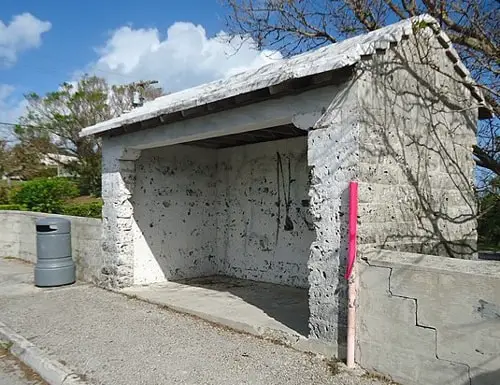
When you are standing on the side of the road, look at the color of the bus stop pole. Pink poles indicate buses heading inbound toward the Central Terminal in Hamilton. Blue poles indicate buses heading outbound away from the city.
A Bus Stop in Bermuda with a pink pole
If you are paying with cash, you must have exact change in coins. The fare boxes do not accept paper bills of any currency, and the drivers cannot make change. When you drop your coins in, you will hear them clink down the slot.
Finally, bring a light layer. The air conditioning on Bermuda buses is notoriously freezing, which feels great for the first five minutes but gets very cold during a 45-minute ride to the Dockyard.
Alternatives to the Public Bus
The easiest alternative is buying an unlimited Transportation Pass, which covers all bus and ferry zones. You can also utilize the direct public ferries. The ferries follow the same 14-zone rule, but most tourist routes default to the 14-zone fare anyway. Check out my
Bermuda Ferry Service page for schedules. For direct beach access without the stops, booking a private minibus or a local taxi is always a highly convenient choice.
About the Author
 By Raj Bhattacharya
Raj has been writing about Bermuda since 2008, when he launched bermuda-attractions.com, one of the longest-standing independent guides to the island. A Certified Bermuda Specialist (Bermuda Tourism Authority), his work draws on personal visits, local contacts in Bermuda, and questions and trip reports from thousands of readers over the years.
Learn more about Raj Bhattacharya
Related Articles
|
Visitors' Reviews and Comments
|