We earn a commission from third-party booking links, at no extra cost to you
Bermuda Beach Safety
Bermuda beaches are some of the safer ones you will find in the Atlantic. The water is clear, the sand on the south shore is famously pink, and the surrounding reef line breaks up most of the heavy ocean swell before it ever reaches the shore. In all my years writing about this island, I have rarely seen a beach incident that genuinely ruined someone's trip.
That said, "rarely" is not "never". A few specific hazards exist on Bermuda's beaches that are different from what you may be used to at a resort beach back home. Two of them, rip currents and Portuguese Man of War, are responsible for almost every serious beach incident I have heard about. If you understand them, you will almost certainly have a wonderful time in the water here.
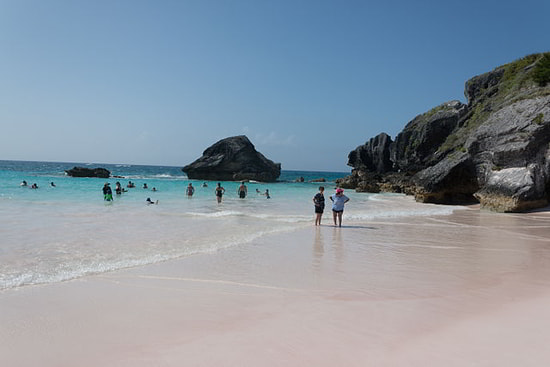
Photo: Captain-tucker, CC by SA 4.0
Life Guards and Beach Warning Flags
Bermuda's lifeguard service is operated by the Department of Parks. Until recently, lifeguard cover was only seasonal. As of December 2025, that has improved meaningfully. Horseshoe Bay Beach, the island's most visited beach by far, now has year round lifeguard service after a team from the United Kingdom's Royal National Lifeboat Institution was brought in to supplement the local crews.
For the other three public beaches with lifeguards, Clearwater Beach, Turtle Bay, and John Smith's Bay, the cover is still seasonal. Lifeguards are typically on duty there from May 24 (Bermuda Day) through Labor Day in early September, generally between 10 a.m. and 6 p.m. Service can be extended on busy holiday weekends like Cup Match (late July to early August), when hours sometimes run from 9 a.m. to 7 p.m. on the key days. Other public beaches do not have any lifeguard cover at all.
The flag system is simple and you should pay attention to it. A white flag on the lifeguard tower means a lifeguard is on duty. A yellow flag means conditions are questionable, and you should check with the lifeguard before going in. A red flag means conditions are unsafe and you should not enter the water.
After hurricanes or major storms, red flags can stay up for several days as the surf settles down. The Parks Department flew red flags island wide for several days after Hurricane Erin in August 2025, even after lifeguard service had resumed, because the swell was still dangerous.
For lifeguard service queries, you can call the Department of Parks on +1 (441) 236-5902.
Rip currents: the single biggest swimming risk
A rip current is a fast, narrow band of water flowing from the shore back out to sea. They form when waves push water onto the beach faster than it can drain off through the usual mechanisms, and the build up finds a channel to escape through. If you get caught in one, you will be pulled away from shore. You will not be pulled under, which is a common misconception. Rip currents are not the same as undertow.
This is genuinely dangerous. In March 2024, a visiting father from Pennsylvania, Hyon Duk Shin, drowned in a rip current at Horseshoe Bay after he managed to rescue a young girl who had been swept out. His family later sued Norwegian Cruise Line, alleging that passengers were not adequately warned about the conditions.
The case was settled out of court in April 2026. Cases like this are mercifully rare in Bermuda, but they happen, and they are usually a combination of strong surf, no lifeguard, and a swimmer who was not aware of the current.
If you get caught in a rip current, the worst thing you can do is fight it by swimming straight back to shore. You will exhaust yourself. The right action is to float, stay calm, and swim parallel to the shoreline (along the beach, not toward it) for a short distance until you are out of the channel. Once you are clear, swim back to shore at an angle. If you are not a confident swimmer, signal for help and conserve your energy.
If you cannot tell whether a beach has currents, just go to a beach with a lifeguard, and only swim when the white or yellow flag is up. That single rule eliminates most of the risk.
Portuguese Man of War
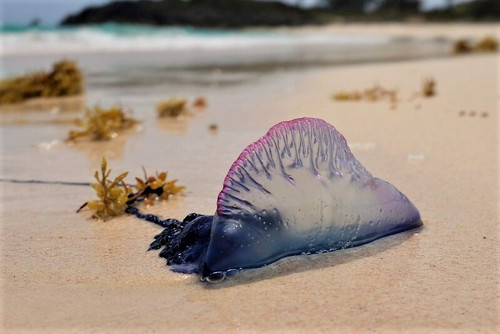
The Portuguese Man of War is a marine creature that looks like a jellyfish but is technically a colonial siphonophore. The body is a purple-blue bladder that floats on the surface, often only a few inches across. Below it, long tentacles trail through the water and these can deliver an extremely painful sting. They can also still sting after the animal has washed up dead on the beach, so do not touch one if you spot it.
In Bermuda, you are most likely to see them in spring and early summer, particularly after a stretch of strong onshore winds, which is what blows them in from the open ocean. The Department of Parks usually issues public warnings when sightings increase, and lifeguards may put up signs at affected beaches. Some days you might see a few on the south shore; most days you will see none at all.
If you spot one in the water, leave the water. If you spot one on the sand, walk around it. If you do get stung, the most important first steps are to get out of the water, carefully remove any visible tentacles using something other than your bare hand (a stick or the edge of a credit card works), and avoid rubbing the area.
Recommendations on rinsing have shifted over the years and are now contested even among experts, so the safest course is to seek medical attention quickly for any sting beyond a small superficial mark, especially if you have any reaction beyond local pain.
I have a separate page that covers the biology, the seasonal pattern, and the full treatment guidance in more detail. Please read
Portuguese Man of War in Bermuda.
Portuguese Man of War at John Smith's Bay Beach
Photo: Peter Burka, flickr, cc by-sa 2.0
Sharks in Bermuda waters
Yes, there are sharks in Bermuda waters, but no, you should not let this stop you from swimming. The species you might encounter (Galapagos, Dusky, and Tiger sharks) are all generally harmless to people if not provoked, and crucially, they stay out at the offshore reef line at places like Argus Bank and Challenger Bank, several miles from any beach. They are not coming inshore to look at swimmers.
Shark attacks in Bermuda are virtually unheard of in modern times. The last incident worth mentioning was many years ago and was minor. If you compare that record to almost any other warm water beach destination, Bermuda comes out remarkably well.
For more on the species, behavior, and conservation status of Bermuda's sharks, see
Sharks in Bermuda.
Can you swim in the Bermuda Triangle?
This question comes up often, so let me settle it. Bermuda sits at one corner of the so-called Bermuda Triangle, the other two being Miami and San Juan. The waters around the island are within the Triangle by definition. People swim in these waters every single day without incident.
The Triangle is a sea legend, not a real navigation hazard. Modern reviews by the US Coast Guard, scientific bodies, and the insurance industry all conclude that the disappearance rate in this part of the Atlantic is no higher than in any other busy stretch of ocean once you account for traffic volume and weather. So yes, swim happily.
Sharp rocks, reefs, and the case for reef shoes
The Bermuda seabed is not all soft sand. Many of the best snorkeling beaches, including Church Bay, have submerged rocks and shallow reef sections that are easy to miss until you bang a knee or stub a toe. Cuts and scrapes from rocks or reef can get infected if not cleaned properly, since ocean water carries plenty of bacteria.
A simple pair of reef shoes (rubber soled water shoes) solves most of this. They protect your feet while letting you walk on or near the reef, and they are cheap and easy to pack. If you plan to do any snorkeling at rocky beaches, bring a pair. You will be glad you did.
Wear sturdy footwear on coastal paths too. Twisted ankles from loose limestone are a real and very avoidable annoyance.
Theft at Bermuda Beaches
Beach theft is not common here, but it is not zero either. The pattern is depressingly familiar: someone leaves a bag with a phone, wallet, or camera on a beach towel, goes in for a swim, and comes back to find it missing.
My honest advice is to not bring valuables to the beach in the first place. If you must, then either go in turns so one person stays with the bag, or use a beach with locker facilities.
Snorkel Park Beach at the Dockyard and Tobacco Bay in St. George both have lockers you can rent by the hour. A waterproof pouch worn under a rash vest is another option for the small essentials like a key card and some cash.
A note on St. George area beaches
I sometimes get asked specifically whether the St. George area is safe for beach visits. The honest answer is yes. Tobacco Bay, Achilles Bay, and the eastern beaches near St. George are well used and have no particular safety issues beyond what applies to any Bermuda beach.
As with anywhere on the island, basic precautions apply: do not leave valuables alone, pay attention to weather and surf, and avoid the quietest stretches of road alone at night. You can read more about the town in the
St. George Bermuda guide.
Things to avoid in Bermuda waters
A short, honest list of don'ts that I keep repeating to first time visitors. Do not swim alone at an unguarded beach, especially in the morning before lifeguards arrive or in the evening after they leave. Do not ignore a red or yellow flag because the water "looks fine"; the danger is often the current you cannot see.
Do not snorkel at a rocky beach without reef shoes. Do not drink alcohol and then swim. Do not approach what looks like a deflating blue balloon on the sand. Do not assume that because the surf is small at one beach, it will be small at every beach on the island. South Shore conditions can be very different from North Shore or East End on the same day.
Sun and skin care
This is technically not "safety" but it ruins more vacations than anything on this page. Bermuda is at a latitude where the sun is much stronger than many visitors expect. Limit midday exposure, especially in the first two days, and reapply sunscreen often.
Note that Bermuda has moved to a reef safe sunscreen standard, and certain chemical sunscreens are banned for use while swimming because they damage the corals. Buy a reef safe brand before you fly, or pick one up locally on arrival.
To sum up
Bermuda's beaches are mostly safe and they remain one of the great pleasures of visiting the island. The risks here are concentrated in a few specific places: rip currents (the biggest one), Portuguese Man of War (occasional), and rocky reef floors (annoying but easy to manage with shoes). Sharks are not a real concern. The Bermuda Triangle is a story, not a hazard. Pay attention to lifeguard flags, do not bring valuables to the beach if you can avoid it, and you will have a fantastic time in the water.
About the Author
 By Raj Bhattacharya
Raj has been writing about Bermuda since 2008, when he launched bermuda-attractions.com, one of the longest-standing independent guides to the island. A Certified Bermuda Specialist (Bermuda Tourism Authority), his work draws on personal visits, local contacts in Bermuda, and questions and trip reports from thousands of readers over the years.
Learn more about Raj Bhattacharya
Related Articles
1) Check out
Is Bermuda Really Safe to understand all other areas of risks in Bermuda and the recommended mitigation measures.
|
Viewers' Reviews and Comments
Robert Hauver (February 2017)
Raj, bought your e-books and am excited to visit there and see the sites. I have a question about the safety of our belongings when swimming at the beaches. As you've mentioned, some beaches have restrooms, which I gather can be used to change into and out of swimwear. How do you keep your valuables safe while at the beaches? If both of us are in the water, no one can watch over them. Appreciate your suggestions or solution. Thanks.
Raj (bermuda-attractions.com) February 2017
Hello Bob, I would advise not to carry valuables (other than essentials) to a public beach in the first place. Having said that, the number of incidents of theft at Bermuda beaches are quite rare and certainly not common. In several popular public beaches like Horseshoe Bay Beach, there are lifeguards on duty who also keep a watch on any suspicious activities.
If both of you must be in water at the same time, ensure that you keep your stuff covered under a towel and make them unnoticeable. And if you need to carry valuables to the beach and want them to be absolutely safe, then choose a beach which has locker facilities such as Snorkel Park (at Royal Naval Dockyard), Tobacco Bay (at St. George), etc. Alternatively, try to use a water resistant pouch or a bag and keep that with yourself unless you have someone on the beach to keep an eye on your stuffs.
Cecilia (March 2015)
Hi Raj, My family and I will be flying to Bermuda the first week of September. We are now a bit concerned because we came across an advisory issued by the US Consulate in Bermuda in 2014 advising of water contamination from raw sewage along the south shore beaches. We have not seen any updates for this advisory or been able to read online as to what has been done to improve this situation.
We are travelling with 2 little kids so we are concerned about their health while swimming at Horseshoe Bay beach. Are you aware of any updates on this advisory? Are there any warning signs posted on the beach if it is unsafe to swim in? Thank you!
Raj (bermuda-attractions.com) March 2015
Hi, following the advisory issued by US Consulate in 2014, the Bermuda Ministry of Health and Environment had given a press release (on March 31, 2014) and reassured the visitors that Bermuda's beaches were safe for swimming. It was also pointed out that the US advisory was based on test results of early 2013 and that too under specific weather conditions like strong winds and wave actions.
The ministry (Department of Health) had also stated that sample water testing is done from various beaches twice every week, and the department has been working towards both short and long term measures to keep the beaches safe for recreational use. That was the last I heard about the above subject. Since then, things seem to be all hunky-dory.
|