We earn a commission from third-party booking links, at no extra cost to you
Bermuda Gombeys: A Complete Guide
Updated: August 2026
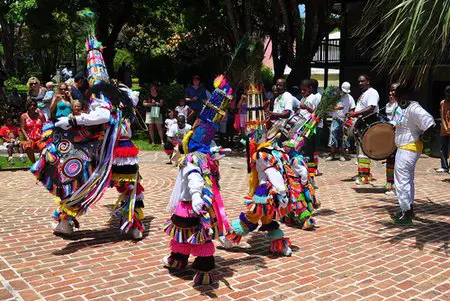
You usually hear them long before you see them. A distant, rhythmic thumping of snare and kettle drums echoes down the narrow lanes, followed by the piercing blast of a whistle. Suddenly, a crowd parts, and a blur of neon fringe, towering peacock feathers, and flashing mirrors bursts into the street.
Watching the Bermuda Gombeys is not a passive experience. It is a loud, fast-paced, and deeply interactive street performance that serves as the heartbeat of Bermudian culture.
This guide covers everything you need to know to find the Gombeys. I will walk you through the active troupes, the best viewing spots, and the unwritten rules of watching a performance.
At a Glance
| Feature |
Details |
| Best Time to Go |
May through mid-September (Wednesdays) or October (Festival) |
| Total Cost Estimate |
Free to watch (bring $1 - $5 bills for tipping) |
| Ideal Duration |
30 - 45 minutes per performance |
| Primary Transport |
Public bus, ferry, or Twizy rental to Hamilton |
Who This Is For / Who Should Skip
If you love live music, cultural history, and street photography, tracking down a Gombey performance should be at the top of your itinerary. Families with children also tend to love the high energy and bright colors.
You should skip this if you are seeking a completely silent, undisturbed holiday. The drums are incredibly loud, often vibrating right in your chest. The crowds that follow the troupes can also get rowdy and tightly packed, which might overwhelm travelers who dislike tight spaces.
Bermuda Gombeys
Photo: Bermuda Tourism Authority
What Are the Bermuda Gombeys? (History and Symbolism)
The Gombey tradition is a unique blend of West African, Native American, and British military cultures. The word "Gombey" itself relates to a specific type of drum from Africa. The tradition started centuries ago, evolving heavily after a 1761 law temporarily banned enslaved people from gathering or dancing.
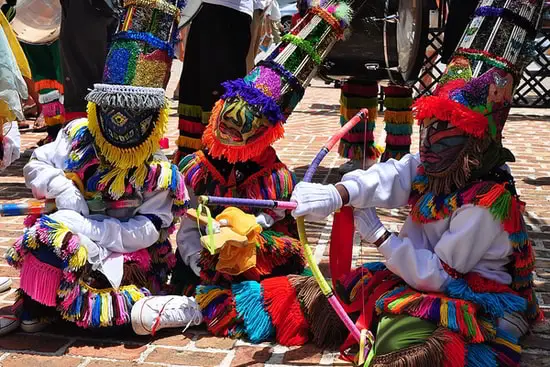
Because of this historical oppression, the performers cover their faces completely with hand-painted masks. This provided anonymity, allowing them to express rebellion and social commentary without fear of punishment. Today, the masks remain a strict requirement, and you will never see a traditional dancer perform bare-faced.
The costumes are packed with deep symbolism. The towering peacock feathers represent pride and resilience. Small mirrors are sewn into the capes to reflect the sun and ward off evil spirits.
Every troupe operates with a strict hierarchy. The Captain leads the group, using a whistle and a long whip to command the rhythm and direct the dancers. Behind the Captain are the lead dancers, the drummers, and often a line of tiny toddlers who are just learning the complex footwork.
Active Gombey Troupes in Bermuda
Bermuda currently has several active troupes, each with their own distinct colors, drum rhythms, and neighborhood loyalties. Families pass these traditions down through generations.
In Bermuda, you might see performances by H&H Gombeys, Place's Gombeys, Gombey Evolution, or the Gombey Warriors. Other prominent groups include the Warwick Gombey Troupe, Phoenix Gombeys, Vibe Tribe, and SMS Village.
Where and When to See the Gombeys
Finding the Gombeys used to rely purely on luck, but today there are several scheduled events where you are guaranteed to see them. Here is where to look.
Harbor Nights: Every Wednesday evening from May through mid-September, Front Street in Hamilton shuts down for a street festival. A Gombey troupe almost always closes out the night, appearing around 9:00 pm.
Gombeys in the City: On Saturday afternoons in the summer, the Bermuda Tourism Authority hosts performances at the Bermuda Marquee sign on Front Street.
Bermuda Day Parade: Held on the fourth Friday in May, this massive parade features multiple troupes battling for crowd approval. Get there early, as the sidewalks pack completely full by 9:00 am.
Boxing Day and New Year's Day: This is when the troupes roam the neighborhoods all day long.
Pro-Tip: If you are visiting during the winter holidays, do not wait around at a bus stop expecting a schedule. Locals use the "Bermuda Gombey Tracker" on Facebook and Instagram. Fans post live updates of where the troupes are marching, allowing you to intercept them in real time.
Gombeys on Front Street
Photo: Bermuda Tourism Authority
The Annual Bermuda Gombey Festival
If you want the ultimate cultural experience, plan your trip around the Bermuda Gombey Festival. Held annually in October, this event usually takes place at the
Botanical Gardens in Paget or Bernard Park in Hamilton.
The festival is a massive showcase where all the active troupes perform in one place. Instead of just passing by in a parade, the groups take turns showing off their most complex choreography. You will also see traditional stilt walkers and community art projects.
Admission is completely free and family-friendly. It is also a fantastic place to try authentic local food. Look for the cash-only vendor tents selling hot fish chowder laced with black rum and sherry peppers, or grab a slice of sweet and savory cassava pie.
What Surprises Visitors the Most
Most visitors are surprised by the sheer physical stamina of the performers. The costumes are made of heavy velvet and wool, and the dancers perform high-speed leaps for miles in the humid summer heat.
The crowd interaction is also unexpected. The Gombeys act like a Pied Piper. When a troupe marches down the street, locals do not just watch from the sidewalk; they fall in line behind the drummers and follow them for miles.
You will also notice people throwing money directly onto the ground in front of the dancers. This is a traditional sign of respect and appreciation for their energy.
Common Mistakes to Avoid
The biggest mistake tourists make is showing up without cash. When the performers do something impressive, you are expected to toss small bills at their feet. Bring a stack of $1 and $5 bills.
A major friction point is crowd awareness. The Captain uses a real whip to keep the crowd back and clear a circle for the dancers. Do not try to push past the front row for a better photo, or you might end up uncomfortably close to a cracking whip.
Finally, do not try to touch the costumes. The capes, masks, and hats are expensive, handmade family heirlooms. Admire them from a few feet away, but keep your hands to yourself.
Practical Details for Visitors
Watching a street performance is entirely free, though tipping is heavily encouraged. If you are driving a rental Twizy to Harbor Nights, park a few streets back from Front Street, as the main road closes to traffic early in the afternoon.
Crowd levels get very high during the Bermuda Day Parade and Harbor Nights. If you are traveling with small children, keep a close eye on them, as the dense crowds and loud drums can be disorienting. Feel free to dance along with the crowd, as participation is highly welcomed.
Alternatives: If This Isn't For You...
If chasing loud street parades in the heat sounds exhausting, you can still learn about this culture in a controlled environment.
Alternatively, if you are interested in the Native American roots of the island, look into the St. David's Islanders Pow Wow. This biennial event offers a quieter, deeply spiritual look at the island's indigenous heritage.
About the Author
 By Raj Bhattacharya
Raj has been writing about Bermuda since 2008, when he launched bermuda-attractions.com, one of the longest-standing independent guides to the island. A Certified Bermuda Specialist (Bermuda Tourism Authority), his work draws on personal visits, local contacts in Bermuda, and questions and trip reports from thousands of readers over the years.
Learn more about Raj Bhattacharya
Related Articles
1) Check out
Bermuda Music and Dance to know about music and dances that are now part of the island's cultural tradition.
|
Visitors' Reviews and Stories
|