We earn a commission from third-party booking links, at no extra cost to you
Helmet Diving in Bermuda: Walk the Reef Without Swimming
So you want to see Bermuda's marine life up close, but you are not a strong swimmer. Maybe you have tried snorkeling and ended up swallowing more seawater than you spotted fish.
Before you give up and settle for a glass-bottom boat ride, let me tell you about helmet diving. It is sometimes also called bell diving or shallow water diving, and on this island it is the easiest way to get face to face with a parrotfish without ever wetting your hair.
I have followed Bermuda's water activities since 2008 through visits, local contacts, and numerous reader trip reports. Helmet diving keeps coming up as the one activity that works for almost everyone in a family, from a nervous eight year old to a grandparent who has not been in the ocean in twenty years. Here is everything you need to know to do it well.
Photo: Harley's Undersea Walk
What Helmet Diving Actually Is
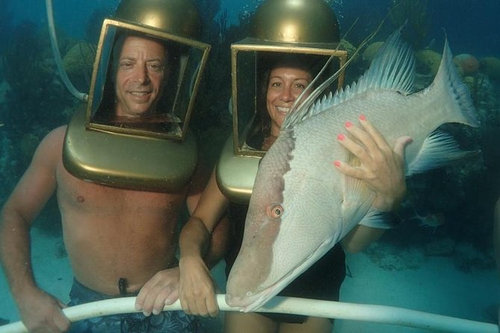
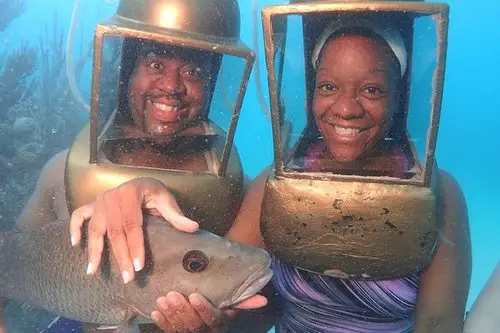
The idea is simple. You wear a heavy brass and metal helmet that sits on your shoulders. A glass faceplate lets you see clearly. Fresh air is pumped down through a hose from a compressor on the boat above, so you breathe normally the whole time.
Your head stays completely dry. Water does not get in through your nose, mouth, or ears. You can wear your prescription glasses or contact lenses. You can have a full beard, makeup, or a hairstyle you do not want ruined, and none of it is a problem.
The helmet weighs about 14 to 18 pounds above water. The moment your shoulders go under, it feels almost weightless because the trapped air inside makes it buoyant. There is no mask squeezing your face, no regulator in your mouth, and no snorkel to bite on. You just walk on the sandy ocean floor and breathe like you would on land.
No swimming ability is needed. No lessons, no certification. The whole appeal is that helmet diving removes the technical barriers of snorkeling and scuba and leaves you with the fun part, which is being underwater watching fish.
How a Typical Helmet Dive Trip Works
The full excursion runs about 3.5 hours. That sounds long for what is essentially a 30 to 40 minute underwater walk, and it is worth understanding why. The boat takes about 30 minutes to reach the dive site, which sits inside the reef line less than two miles from shore.
Once anchored, divers go down in small groups of five to seven at a time. With a full boat of around 20 divers, you may have three or four dives running back to back. While one group is underwater, the others wait on board, watch through the glass-bottom panels, and take their turn next.
So the math goes like this: 30 minutes out, three dive rotations of about 35 minutes each plus changeover time, then 30 minutes back. The waiting time is not wasted. The crew talks you through the marine life, you can see your friends underwater through the glass bottom, and there are usually fruit drinks and snacks. If the water is below 80 degrees Fahrenheit, hot chocolate appears.
Photo: Harley's Undersea Walk
My Walk on the Sea Floor
Let me walk you through what it actually feels like. On my dive, our group of six climbed down a padded ladder at the stern of the boat. The water was at shoulder level when our guide, Paul, lowered the helmet onto each of us. I heard the bubbles rising as the air started flowing. We kept climbing down until our feet touched soft white sand about 10 feet below the surface.
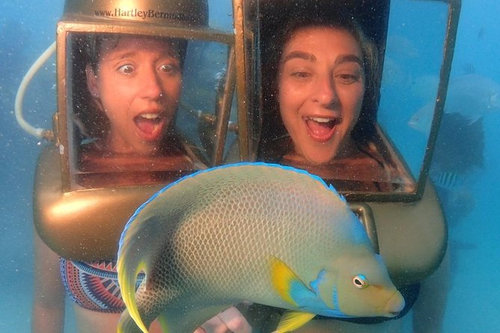
Paul handed us a long bar to hold onto, the idea being to keep the group close together so the underwater cameras can film everyone. He passed me an open mussel, and within seconds a cluster of sergeant majors and a butterfly fish were nudging my fingers. A red squirrelfish and a sparkling parrotfish followed us for most of the walk, sometimes hovering inches from the glass.
The corals here are the slow stars of the show. Paul pointed at one that looked like a bare tree, dormant for the day. He showed us another that was wide open, greenish, with tiny flower-like polyps waving in the current. Each of us got a magnifying glass. Paul placed a sliver of fish on the polyps and they grabbed it instantly with their tentacles. He pointed at a third coral and mimed a sting, warning us not to touch.
We stopped beside a sponge. Paul sprinkled sand over its breathing holes and the sponge promptly exhaled a small cloud, scattering the grains. A sea cucumber was passed around so we could feel its soft, leathery skin. Thirty-five minutes vanished. The walk back to the ladder felt too quick.
Above the water, Paul told us about Theodore and Samantha, the two hogfish who come around for mussels and let you hand-feed them when they show up. His favorite memory was taking a blind diver under and watching him use his hands to feel an entire fish that swam right into his arms. The man came up shouting that he had seen everything.
That story stuck with me. Helmet diving is special for people with full vision. For people without it, or for people with mobility issues who cannot easily walk on land, it can be life changing.
Photo: Harley's Undersea Walk
Pro Tip
Walking on sand underwater is actually easier than walking on sand above water. The buoyancy of the helmet takes weight off your knees and hips. People who use collapsible wheelchairs, amputees, and visitors with multiple sclerosis or cerebral palsy have all done this dive successfully. If you have any doubt, call the operator before you book and they will talk you through it.
Top Helmet dive operators in Bermuda
There is realistically one option left, and the good news is it is the original one. The Hartley family has been running undersea walks in Bermuda since 1947, when Bronson Hartley pioneered the concept. His son Greg now runs the operation.
The two other helmet diving outfits that used to share this listing, Bermuda Bell Diving (formerly Hartley's Underwater Wonderland, taken over by Paul Pike and rebranded) and Peppercorn Diving Center out of St. George, are both closed. Paul Pike has retired. So if you want to do this in Bermuda, you are going to Hartley's.
Hartley's Undersea Walk
The boat is the 40-foot Rainbow Runner, with a glass bottom, a proper bathroom, a changing room, a freshwater shower, and a shaded sundeck. It is comfortable, not cramped, even when the boat is at capacity.
The dive site sits less than two miles from shore inside the reef line, in 8 to 12 feet of clear turquoise water. Greg has been diving the same spot since 1984. The fish there know him.
Several have names and personalities that the crew introduce to you underwater through written waterproof messages: Diana the Bermuda angelfish, Charles the hogfish, Donald the grey snapper, Gollum the squirrelfish, and Herb the hind. Some will let you pet them. Some pose for photos. A couple do small tricks.
Departure Point
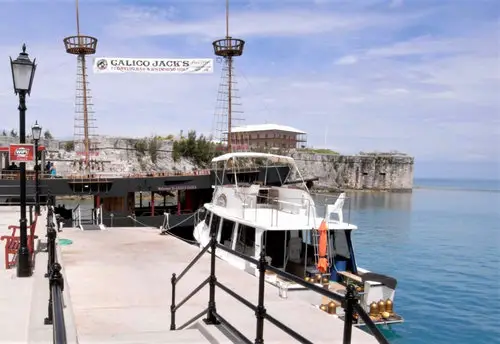
Here is an important update from the older guidance you may find on other sites. Hartley's no longer leaves from the Mangrove Bay Public Dock in Sandys Parish. The pickup is now at Heritage Wharf in the
Royal Naval Dockyard, right next to where the cruise ships dock.
Photo: Hartley's
The Rainbow Runner ties up against the dock face perpendicular to Heritage Wharf, next to the floating bar Calico Jack's and the Longtail catamaran. Look for the white circular Moongate across the road from the Island Tour Centre. The boat is parked just past it.
For cruise passengers arriving at Heritage Wharf or King's Wharf, this is a five minute walk at most. That alone makes Hartley's one of the easiest excursions for cruisers in Bermuda.
Schedule and Season
Departure times: 9:30 am and 1:30 pm, both per person and charter trips
Extra trips: Sometimes a 2:30 pm or 3 pm slot is added if a cruise ship like Vision of the Seas is in port and demand is high
Noon trips: Occasionally offered after daylight saving ends and no ships are in port
Arrive: 20 to 30 minutes before departure
Operating season: April through October, six days a week. Generally closed Sundays and public holidays, plus the winter season. After the new year the ropes come in and they are fully closed
November and December: Sometimes available as a private charter only, depending on weather
Indicative Prices
Adult divers (13 and over): $150
Children (5 to 12): $130
Riders along (no dive, just the boat): $65 to $75
Charter premium: $300 on top of per person rates, gives you exclusive use of the boat
Photos and short video on thumb drive: Included in the dive price on direct bookings through Hartley's
Minimum age: 5 years old
Admin fee: A $5 non-refundable booking fee may apply through some third-party resellers
Cancellation: Full refund if you cancel at least 24 hours before departure
Minimum group sizes shift with the season. In the slow shoulder months it is two people. In June and September it goes to three. In July and August it is four. If you are a couple traveling in low season and want guaranteed departure, the $300 charter add-on can make sense because you skip the wait time between groups and get the whole dive to yourselves.
Booking and Contact Details
You can book directly with Hartley's or through Viator and other resellers. Direct booking sometimes includes photos and the thumb drive video at no extra charge.
Toll Free (US): 1-866-836-3989
In Bermuda: 441-234-3535
Best time to call: 7 am to 9 pm EST
Who Can Do It and Who Should Think Twice
Hartley's takes divers from age 5 upward, with no upper age limit. The oldest divers I have heard about have been in their late eighties. Pregnancy, recent ear surgery, serious heart conditions, and a few other medical issues are reasons to consult the operator first.
Bermuda authorities require a health questionnaire to be completed before you dive. If you call ahead with any concern, they will tell you straight whether it is safe.
You do not need to swim. You do not need to put your face in the water beforehand. You do not need to equalize your ears the way scuba divers do, because the descent is only 10 feet and the helmet keeps air pressure inside it constant.
What you do need is the ability to walk down a nine foot ladder while wearing a heavy helmet, then walk on a sandy bottom holding onto a bar. The crew helps with everything, including lifting and lowering the helmet onto your shoulders.
What to Bring
The basics are short.
A bathing suit, worn under your clothes
A towel (not always provided, so bring your own)
A change of clothes for after
Reef-safe sunscreen, applied before you board
A waterproof camera or a GoPro if you want your own footage
Cash for tips for the crew, which are not included and are appreciated
Your prescription glasses if you wear them. They work fine inside the helmet
Getting There from Wherever You Are Staying
Since the departure is at Dockyard now, getting there is straightforward.
From cruise ships: You are already at Dockyard. Walk over.
From Hamilton: Take the ferry on the Blue Route (Hamilton to Dockyard), which takes about 20 minutes and is one of the most scenic transfers on the island. A one-way fare costs $5.50 cash or you can use a token or transportation pass. Check current schedules before you go.
From the south shore parishes (Warwick, Southampton, Paget): Bus 7 or 8 runs from Hamilton to Dockyard along the south road. The full route from Hamilton takes around an hour.
From St. George at the east end: This is the longest haul. Take bus 1, 3, 10, or 11 to Hamilton, then transfer to Bus 7 or 8, or take the ferry. Allow well over two hours one way, so plan the morning trip and accept it will be an early start.
Twizy or scooter rental: A Renault Twizy is a small electric two-seater that visitors can rent. It is one of the very few cars tourists can drive in Bermuda. Parking is easy at Dockyard.
Combining the Dive with the Rest of Your Day
If you take the 9:30 am trip, you will be back at Dockyard around 1 pm with plenty of afternoon left. A few good ways to use it:
Walk over to Horseshoe Bay Beach by taking the public minibus shuttle that runs from Dockyard down to the south shore beaches in season. Bus 7 also works.
Eat at the Frog and Onion Pub inside the old cooperage building at Dockyard. Try the proper Bermuda fish chowder, served with a tiny bottle of black rum and sherry peppers on the side to dress it yourself. That is the local way.
Browse the Clocktower Mall and the Bermuda Craft Market for cedar work and local art.
Visit the National Museum of Bermuda inside the old fort walls.
If you take the 1:30 pm trip, you will be back around 5 pm. That works well if you want a relaxed morning at the beach first.
Pro Tip
If you are a cruise passenger docked for three days, do not try to cram the dive, lunch, and Horseshoe Bay into the same day unless you take the morning slot. The boat sometimes runs a few minutes late because of weather or earlier groups, and a delayed return can squeeze the rest of your plans.
A Few Final Honest Notes
Greg has been doing this for over forty years. He runs a tight ship, knows his fish by name, and gives a genuinely good underwater biology lesson. He is also opinionated and direct on board, which some readers have loved and a few have found a bit much. Go in expecting personality, not a polished cruise-line script. The underwater experience itself is what people remember, and that part is consistently excellent.
If you are deciding between this and snorkeling at Tobacco Bay or Church Bay, do not think of helmet diving as a snorkeling alternative. It is a different thing. You go deeper, you stay longer, you touch and feed marine life, and you do it with a guide. It costs more, but you get a guided 30 to 40 minute encounter that you will not get any other way on the island.
About the Author
 By Raj Bhattacharya
Raj has been writing about Bermuda since 2008, when he launched bermuda-attractions.com, one of the longest-standing independent guides to the island. A Certified Bermuda Specialist (Bermuda Tourism Authority), his work draws on personal visits, local contacts in Bermuda, and questions and trip reports from thousands of readers over the years.
Learn more about Raj Bhattacharya
Related Articles
|
Visitors' Reviews and Comments
Phyllis Sisco (June 2013)
What is usually the earliest scheduled time to go for this? How far from the dockyard since we are taking NCL cruise? We were thinking doing your trip then go to lunch then horseshoe beach. Is that too much in one day even if we are docked for almost 3 days. thanks. Never did this so we are trying to plan accordingly.
Raj (bermuda-attractions.com) June 2013
Hi, Are you planning with Hartley's Undersea Walk (Helmet Diving)? They usually have daily trips at 9:30am and 1:30pm. The entire trip last for about 3 to 4 hours which includes reaching the dive area by boat, dive time (about 25-30 minutes for each group of 6-7 and they usually take up to 24-28 divers in a boat), plus returning. The boat leaves from the small dock near the moongate at Heritage Wharf in dockyard itself. The NCL cruise docks at Heritage Wharf, and so it'll be only few steps walk from the pier.
If you take the morning trip, you can easily visit Horseshoe bay beach after lunch (bus #7 or take the minibus shuttle service). Regards,
|