We earn a commission from third-party booking links, at no extra cost to you
The Astor Estate in Bermuda: History, Glamour, and Current Status
Updated: October 2026
If you wander through the eastern end of Bermuda near St. George's Parish, you might hear whispers of a Gilded Age mansion hidden in the trees.
The Astor Estate Bermuda is a fascinating piece of local history tied to unimaginable wealth, a private train line, and the Titanic tragedy. Today, this property is not a traditional tourist attraction with ticket booths and guided tours.
Instead, the former Astor residence is a private residential complex. I have seen many visitors drive their rented mini cars down narrow, winding roads expecting a museum, only to find a private driveway.
This guide will walk you through the incredible history of the Astor family home and show you how to best experience the surrounding area without trespassing.
At a Glance
| Category |
Details |
| Best Time to Go |
Year-round, but spring offers the best weather for walking nearby trails. |
| Total Cost Estimate |
Free (viewing from public trails or the water). |
| Ideal Duration |
1 to 2 hours for walking the adjacent public park. |
| Primary Transport |
EV mini car, rental scooter, or taxi to Ferry Reach Park. |
| Public Access |
None. The estate is private property. |
Vincent Astor and The Titanic Inheritance
To understand the scale of the Astor Estate, you have to look at the man who built it. Vincent Astor was just 20 years old when his father, John Jacob Astor IV, died aboard the RMS Titanic in 1912. Vincent suddenly inherited a massive fortune.
Vincent Astor inherited roughly 69 million dollars at the time. Adjusted for inflation, that made him a multi-billionaire. Unlike his father, Vincent focused heavily on philanthropy and quiet escapes from the New York social scene.
People often ask, is the Astor family still around? While the broader Astor family tree has many branches in the US and the UK, Vincent himself died childless in 1959 at the age of 67.
He left the bulk of his massive fortune to the Vincent Astor Foundation, which was managed by his widow, Brooke Astor, until her passing.
Building the Ferry Reach Mansion (1933)
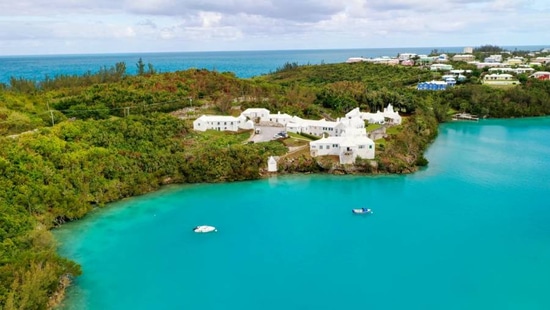
In 1932, Vincent purchased 22 acres of rugged, cedar-covered land in Ferry Reach Bermuda. He hired a prominent local architect to build a sprawling limestone mansion that was completed in 1933. The Astor House Bermuda was designed to be a completely self-sufficient retreat.
Photo: The Bermudian Magazine
The property featured a massive main house, a private cinema, and an outdoor seawater aquarium. Astor even built a separate guest cottage for his close friend, President Franklin D. Roosevelt.
The estate was a masterpiece of traditional
Bermuda architecture, complete with a classic white stepped roof to catch rainwater.
The mansion and many other areas in the property offer a wonderful view of the
Castle Harbor towards south, and the Atlantic towards the north.
The Private Miniature Railway
One of the most fascinating details of the Astor Estate was its transportation system. Vincent Astor loved trains. He actually built a private, narrow-gauge miniature railway right on his property.
When wealthy guests arrived in Bermuda, they took the main public train along the
Bermuda Railway Trail. Astor built a specific junction called
Astor's Siding. Guests would step off the main train and board Astor's private rail cars, which took them directly to the front doors of the Astor Court.
Vincent Astor and his mini train in Bermuda
(Photo: Life Magazine)
WW II, Kindley Field, and Astor's Departure
The peace and quiet of the estate did not last forever. During World War II, the US military struck a deal to build an airbase in Bermuda. They constructed Kindley Field right across the water from Astor's property.
The constant, deafening roar of military aircraft completely ruined the tranquil atmosphere of the estate. Frustrated by the noise and the loss of privacy, Vincent Astor sold the property in the mid-1940s. He never returned to the island.
Today, that same airfield operates as the L.F. Wade International Airport. Modern commercial jets still fly directly over this area, proving Astor's point about the noise.
The 1962 Plane Crash and The Cuban Missile Crisis
The estate's connection to the military base led to a dramatic historical event. In October 1962, during the height of the Cuban Missile Crisis, a US Air Force plane lost power shortly after takeoff. The fully fueled aircraft crashed directly into the estate's boathouse.
The resulting explosion and fire caused massive damage to the shoreline structures. Miraculously, the main house survived the blast. Local first responders spent days securing the area, and the scars on the coastal limestone are still visible if you know exactly where to look from the water.
The Bierman Era: The Estate Today
After Astor left, the property changed hands and was eventually purchased by the Bierman family. In local real estate circles, it is widely known today as the Bierman Astor Estate. The massive mansion was subdivided into multiple private apartments and a cottage.
Because it is a private complex, you cannot walk up and knock on the door. The property occasionally pops up on the luxury real estate market as a multi-million dollar investment opportunity. Please respect the privacy of the current residents and do not attempt to enter the driveway.
Eyewitness Memories: An Oral History of the Estate
Over the years, locals and visitors have shared incredible firsthand accounts of the estate. These stories give us a rare glimpse into the property's past. You will find more information in the comments section at the bottom of this article.
|
The First Responder: "I was stationed at the base in 1962. When that plane went down, the heat from the boathouse fire could be felt across the water. We spent hours trying to contain the fuel spill."
|
|
The Doctor's Son: "My father was a local physician who occasionally treated the residents. In the 1970s, I got to swim in the massive pool. You could still see the grand scale of the old Astor money everywhere."
|
|
The Railway Hunter: "Back in the early 1990s, I hiked through the thick brush near the edge of the property. I actually found rusted sections of the old miniature train tracks half-buried in the dirt."
|
How to Explore the Surrounding Area
Since you cannot tour the house itself, the best way to experience the area is by visiting the adjacent public lands. Head over to
Ferry Point Park, also known as Ferry Reach Park, a massive 64-acre public reserve down the Ferry Road in St. George's Parish.
Take bus no. 10, or 11 from Hamilton, and get off at the junction of Mullet Bay Road and Ferry Road. Then walk down
Ferry Road. You can see the boundary of Astor Estate, but you can not enter the compound. Instead, enter the Ferry Point Park.
Walk along the coastal trails toward Lover's Lake. You will get beautiful views of the water and the same ocean breezes that drew Vincent Astor here nearly a century ago.
Pro-Tip: If you rent a scooter or a Twizy, park near the entrance of Ferry Reach Park. The limestone walking paths here can be quite slippery after a quick island rain shower, so wear shoes with good grip.
If you want a taste of local flavor after your hike, stop by a nearby pub in
St. George's for a bowl of Bermuda fish chowder, generously dashed with black rum and sherry peppers.
About the Author
 By Raj Bhattacharya
Raj has been writing about Bermuda since 2008, when he launched bermuda-attractions.com, one of the longest-standing independent guides to the island. A Certified Bermuda Specialist (Bermuda Tourism Authority), his work draws on personal visits, local contacts in Bermuda, and questions and trip reports from thousands of readers over the years.
Learn more about Raj Bhattacharya
Related Articles
|
Visitors' Reviews and Comments
John S Fox (March 2023)
As a PC in St George's, I was the first officer called out and stationed at that crash site while it still smouldered in the early morning before the Kindley base police could arrive?. There wasn't much (anything) left of the plane or the grounds because the plane had been fully fueled. One of my less perfect times in wonderful Bermuda in the early 60s.
Pete Hookings (March 2014)
In the late 1930s and 1940s, My dad Carl Hookings, MD lived in St George. My dad was Vincent's doctor and friend. I was around five years old. I learned to swim in Astor's pool. We would visit on occasion and Mr. Astor would meet us at the train station with his little train if we did not come by carriage. During the war he could not come to Bermuda and his place was taken care of by Percy and Mable Hammond. We went there frequently and used his boats, house and estate for weekends and parties, The Hammonds were like an aunt and uncle to me. During the 1940s they built Kindley Field and planes flew over the house almost every ten minutes.
I met Chuck Yeager at one of our parties. He was an officer in the USAAF. After the war the Astors did not want to be in the flight path of all the planes and they sold the property to Carl Biermann and his family turned the place into condos. Michael and Annette Biermann still own the place as well as the property over to the north shore. The boat house was hit by a plane taking off during the Cuban Missle crisis so it exists no longer.
My wife and I visited with Annette several years ago and she gave us a tour. WE didn't go inside the house so I don't know how they condoed it. To this day it was one of the most beautiful layouts I have ever seen. I lived at Crooked Elbow in St Georges, Kington House on the harbor road, Watlington House in Devonshire, now the Ocean View Golf Course, and at Deepdeene in Smiths Parish. My father was with the Health Department after we left St. Georges. Henry Wilkinson was his associate. Dr. Wilkinson wrote a history of Bermuda as did Canopn Tucker of St. Peters Church in St. George. My father was a third generation Bermudian.
Mark Goodwin (December 2011)
Dear sir, I lived and worked in Bermuda for many years, I worked at Bermuda Machine and Casting Co in St George's. We seemed to work all over the island maintaining the hotels, hospitals and tourist attractions. I remember going to ferry reach, we drove towards the end where there is a small lagoon, from there you can walk back down the old railway line. If you continue down the railway for a mile or two, and keep your eyes peeled to your right, you will come across the remains of Vincent Astor's miniature steam train and carriage. although this was in 1992 I'm sure they will still be there!!! Best regards.
Jim Booska (June 2011)
Hi, I'm looking for the actual location of the old Vincent Astor estate. Was the estate in the Ferry Reach Park or on Coney island? Is Coney island included in the ferry reach park area? Thanks for your site and help.
Raj (bermuda-attractions.com) June 2011
Hi, Astor Estate is located next to Ferry Reach Park. You can see the estate boundaries from Ferry Road. Coney Island is not part of Ferry Reach Park and is located at the other side of the water channel. Coney Island is connected to the main island of Bermuda by a bridge (at Bailey's bay), whereas Ferry Reach Park is located in St. George's parish.
|