We earn a commission from third-party booking links, at no extra cost to you
Whale Watching in Bermuda: Tour and Viewing Guide
Updated: September 2026
Every spring, roughly 10,000 humpback whales leave their breeding grounds in the Caribbean and head north toward Canada, Iceland, and Greenland. Bermuda sits directly in their path, creating a spectacular mid-ocean resting stop.
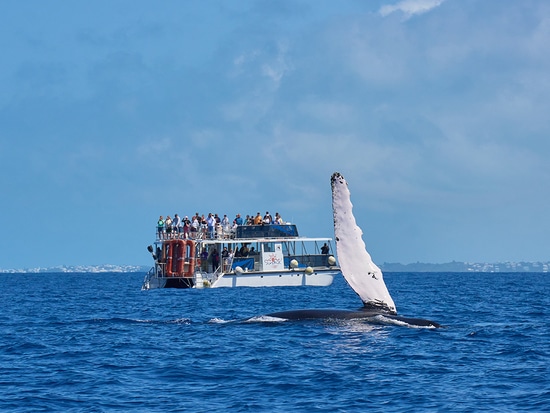
Typically between March and late April, these massive mammals gather just offshore to feed, play, and nurse their calves. If you are visiting during this narrow window, witnessing a 40-ton whale breach against the horizon is an unforgettable experience.
Photo: Bermuda Tourism Authority
However, getting out to the viewing zones requires a bit of planning and a strong stomach. Here is exactly what you need to know to book a boat tour or find the perfect shore viewing spot.
At a Glance
| Feature |
Details |
| Best Time to Go |
Typically March through late April. |
| Total Cost Estimate |
Typically $100 - $130 per adult. |
| Ideal Duration |
5 to 6 hours. |
| Primary Transport |
Tour boats from Dockyard, Hamilton, or Flatt's. |
| Viewing Distance |
100 meters (strictly enforced Bermuda law). |
Who This Is For (And Who Should Skip It)
Whale watching is perfect for nature photographers and adventurous travelers looking to experience the raw power of the Atlantic. It is a long day on the water, but the payoff of seeing a mother and calf swimming together is worth the effort.
You should skip the boat tours if you are traveling with toddlers. The major operators enforce strict minimum age limits, usually between 5 and 10 years old, for safety reasons.
You should also pass if you suffer from severe motion sickness. The viewing areas are out on the open ocean, far beyond the protective coral reefs.
What Surprises Visitors the Most
Most visitors are completely unprepared for the unparalleled clarity of the deep water here. Because the ocean is so clear, you do not just see the whales when they break the surface.
You can often see them glowing a brilliant turquoise color as they glide 30 feet underwater right next to the boat.
The second biggest surprise is the ocean swell. The primary viewing spots, like the Challenger Banks, are located miles offshore. Even on a sunny day with blue skies, the Atlantic swells can be large, making the boat rock significantly when the captain cuts the engines.
The Best Whale Watching Boat Tours
The whales are usually seen at Sally Tucker and Challenger sea mounts which are some 2 to 15 miles offshore. The commercial tour landscape has shifted, and three main operators now provide the most reliable offshore experiences.
Photo: Bermuda Tourism Authority
Island Tour Centre / Fantasea
This is the most popular option for general visitors. They operate out of the
Royal Naval Dockyard using a large 65-foot catamaran called the Sundeck.
The dual-hull design makes it one of the most stable boats in the fleet, which helps reduce seasickness. They have a cash bar onboard, and the minimum age to ride is 5 years old.
Bermuda Zoological Society (BZS)
If you want an educational focus, book with BZS. They depart from Flatt's Inlet on a 45-foot research vessel named Endurance. These trips are heavily focused on conservation, and your ticket supports local marine research.
Because the boat is smaller and the focus is scientific, they enforce a strict minimum age of 10 years old.
K.S. WaterSports
Departing from both Hamilton and Dockyard, this operator uses a modern 50-foot Power Catamaran. This vessel is faster than the traditional tour boats, meaning you spend less time transiting and more time out on the banks. It is a great choice if you want a slightly more thrilling ride out to the viewing zones.
How to Watch Whales from the Shore
If you want to stay on solid ground, head to
West Whale Bay Beach in Southampton Parish. This public park sits on a cliffside facing the southwest, offering a wide, unobstructed view of the ocean.
Bring a blanket, a picnic, and the most powerful binoculars you can find. You will want to set up on the grassy hill near the old fort battery, not down on the sand. The parking lot is quite small, and the stone steps leading down to the beach area can be slick, so wear shoes with good traction.
You will need patience, but on a clear April day, you can often spot the white splashes of breaching whales on the horizon.
Common Mistakes to Avoid
Ignoring the weather policy: Offshore tours are frequently canceled due to high winds and dangerous swells. Book your tour for the very beginning of your vacation. If the captain cancels your trip, you will still have a few days left to reschedule.
Expecting a petting zoo: Bermuda has strict marine protection laws. Captains are legally required to cut their engines and stay at least 100 meters away from the whales. While curious whales will sometimes swim right up to the stationary boat, the captain cannot actively chase them down.
Forgetting seasickness prep: Do not assume you will be fine just because you have been on a boat before. The Challenger Banks are unprotected open ocean. Take your preferred motion sickness medication well before you board the boat, not after you start feeling ill.
PRO-TIP: Beat the Atlantic Swell
Don't let the open-ocean roll ruin your viewing experience. Stop by The Phoenix Centre (the island’s primary drugstore chain, with convenient locations on Reid Street in Hamilton and in the Dockyard) before your tour day. Many locals and seasoned travelers swear by acupressure Sea-Bands or non-drowsy ginger capsules to help manage the chop. Check anyway with a medical doctor.
What to Pack for Your Tour
Spring air in Bermuda is comfortable, but the wind chill out on the ocean drops the temperature significantly. Bring a solid windbreaker or a light waterproof jacket.
You must pack polarized sunglasses. Standard sunglasses just darken the view, but polarized lenses cut through the ocean glare, allowing you to see the whales swimming beneath the surface.
Bring non-spray reef-safe sunscreen to avoid spraying your fellow passengers in the wind. Finally, bring a bit of cash for the onboard bars and to tip the crew at the end of the trip.
Alternatives: If Offshore Whale Watching Isn't for You
If you are visiting outside of the typical March to April window, or if the thought of open ocean swells makes you nervous, you still have great marine options.
Alternatively, you can stay entirely dry and visit the
Bermuda Underwater Exploration Institute (BUEI) near Hamilton. Their deep-sea exhibits and interactive marine displays offer a fantastic look at the ocean life surrounding the island without the risk of seasickness.
Another fantastic land-based option is the
Bermuda Aquarium, Museum and Zoo (BAMZ) in Flatt's Village. If you are traveling with young children who do not meet the strict minimum age requirements for the offshore whale watching boats, this is the perfect compromise.
Kids can get up close to harbor seals, rescued sea turtles, and vibrant reef fish in the protected indoor exhibits, keeping the whole family entertained without ever stepping foot on a rocking boat.
Humpback Whale Facts and FAQs.
During the spring, about 10,000 Humpback whales migrate past Bermuda's shores every year towards the north Atlantic zone for feeding.
They travel for about 16,000 miles during this time. This is considered one of the longest migrations of mammals in the world.
An adult humpback whale can be from 40 - 50 foot long. Sometimes they can be even longer. On an average, they would weigh about 40 - 50 tons.
Humpback whales have long white flippers. You can sometimes see them swimming upside down with their flippers in the air.
There are distinct black and white marks on the underside of their tail flukes. These marks can be used by experts to identify individual whales.
Look for how they slap their huge tails on the water surface.
On their slightly flattened heads, you will see bumps.
Unlike other species, humpback whales are very acrobatic. If you are lucky, you will see them breaching, i.e. throwing their entire body out of water.
As they come out of water surface, they often blow a stream of spray that can rise up to 12 feet above the water. After blowing for 3 to 4 times, a humpback usually dives back into the water and remains underwater for about 15 minutes.
Average whale calves are born about 12-15 foot in length and weigh about 3,000 pounds each.
Did you know a newborn humpback calf drinks up to 120 gallons of milk every single day while resting in Bermuda's waters?
About the Author
 By Raj Bhattacharya
Raj has been writing about Bermuda since 2008, when he launched bermuda-attractions.com, one of the longest-standing independent guides to the island. A Certified Bermuda Specialist (Bermuda Tourism Authority), his work draws on personal visits, local contacts in Bermuda, and questions and trip reports from thousands of readers over the years.
Learn more about Raj Bhattacharya
Related Articles
|
Visitors' Reviews and Comments
Jeanene (January 2018)
Hello, Went to Bermuda for my 40 birthday last year but couldn't do whale watching because it was cancelled due to winds. Heading back to Bermuda in June and I know whale watching is not available. My friends and I are willing and contemplating flying into Bermuda for a day to go whale watching.
Can you help me possible plan this out, best whale watching company in terms of number to make reservation, best time between March and April to go, hotel in close proximity and relatively inexpensive as it will only be for evening.
Raj (bermuda-attractions.com) January 2018
Hi Fantasea (Island Tour Centre) is the oldest operator in the island for whale watching boat tours and they are one of the best. Any time between March to April should be a good time, but it also depends on the day's weather.
They usually operate from Royal Naval Dockyard (near the ferry dock) and so staying in a hotel in Sandys or Southampton would be convenient.
Arthur Groten (February 2014)
As near as I can tell, the only time that there is a significant chance to see the whales in March-May. Is that correct or is there an opportunity in July? Thanks
Raj (bermuda-attractions.com) February 2014
Hi, March to April is the best time for whale watching. This is when the humpback whales migrate through Bermuda waters. In July the possibility is very low.
|