We earn a commission from third-party booking links, at no extra cost to you
Spittal Pond Nature Reserve
About Spittal Pond Reserve
Spittal Pond, located in Smiths Parish Bermuda, is the largest and the most premium nature reserve and national park of the island. It spreads over some 64-acres of land area. This Nature Reserve is co-owned by Bermuda National Trust and Bermuda Government.
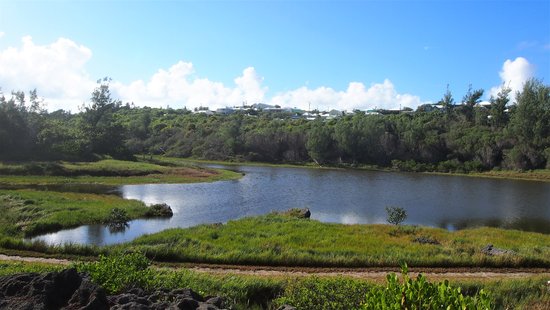
The reserve stretches along the south shore coastal line and at its center is the 8-acre Spittal Pond. It’s a sprawling sanctuary with a valley having a large brackish pond, several other freshwater ponds with surrounding marsh and woodland areas.
There is a winding trail through all these climbing to a spectacular views over the south shore. This area originally was comprised of 10 strips of privately held land. However due to large parts being salt marshes, it was unsuitable for development.
In 1946, historian and conservationist Dr. Henry Wilkinson purchased a land at the eastern end and later donated the 4.2 acres land area to Bermuda National Trust in 1973.
Bermuda Government purchased the remaining areas as and when they became available. Some areas in the western side has been leased out to dairy farmers.
In 1966 the first nature trail was created around the park. It was only in 1986 when Spittal Pond actually became a protected nature reserve under the National Park act.
The Nature Trail
The Reserve has two entrances along South Road. Both have parking lots and lead to the winding trail. We entered through the western entrance.
From the parking lot we followed the trail through the woods. Here we saw
Bermuda Cedar and prickly pear cactus.
As you go through the woodland area, you can see trees like olivewoods, casuarinas as well as palmettos and pittosporum. There are also many spice trees and Mexican pepper trees along the trail.
You will see lots of wildflowers as well like the Jamaican wireweed with its tiny beautiful pale apricot flowers. As we came out of the wooded area, Spittal Pond was on the left.
Spittal Pond Imagery. Rotate the image for 360° view.
Use the arrows to move along the trail.
The pond itself is a wildlife sanctuary and protected by a fence. Just before the gate to the sanctuary and to the right is the strange Checkerboard, an unusual geological formation on the coastline. It is a large flat floor of limestone with grooves that divide it into squares.
We heard that even experts are unable to confirm whether human hands or the sea had crafted such work. The area is undoubtedly of great interest to the geologists.
We also came to know that in 18th century, whalers used this place to strip the whales after they were hauled to the shore.
If you look over the coastline, with some luck you can even get a sight of the migrating whales from here during the migration season (March - April). Some sections of the coastline are
favorite shore-fishing spots for the locals.
The Spittal Pond is also a large bird sanctuary and one of the best
bird watching locations in Bermuda. Most of the bird-life can be seen from the trail itself. From October to May, the reserve becomes home to a wide variety of migratory shorebirds and waterfowl.
Resident birds in the forest area include Kiskadee, Grey Catbird, White-eyed Vireo, Northern Cardinal and European Goldfinch. During the winter time, you can spot black and white Warblers, American Redstart, Ovenbird and Northern Waterthrush.
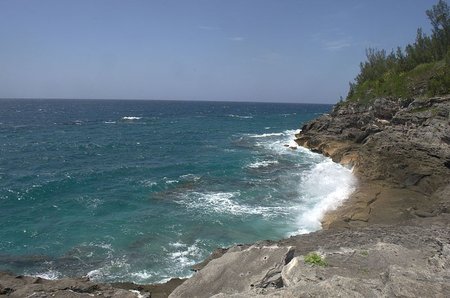
Cliffs and Shoreline at Spittal Pond Nature Reserve
Photo: James Shelton32, cc by-sa 4.0
We have spotted birds like woodland cardinals, finches, mallards, turnstones, sandpipers, white long tails, blue herons, white egrets, occasionally visiting hawks, and the yellow crowned night herons.
Next was the
Jeffrey’s Hole, a cave with an overhead hole. This was once used as a temporary shelter by a slave who tried to escape his master. Go through
Jeffrey’s Hole to know about the full story.
Further up the trail is the Spanish Rock, a historic carving on an exposed rocky cliff face. It’s believed to be the work of Portuguese sailors from a wrecked ship.
The inscription, now cast in bronze, includes letters that look like "RP" possibly for Rex Portugaliae, referring to Portugal’s king and dated 1543. The original rock no longer exists and a bronze cast of the original stands in its place today.
Self-Guided Tour of Spittal Pond Nature Reserve
As you explore habitats hosting over 200 bird species, please stick to the paths for your safety and keep noise levels down to avoid scaring the wildlife. Remember the reserve's motto: "Take only memories, leave only footprints".
Station 1: Introduction to Endemic Trees
Observe the Bermuda Cedar, a historic tree whose wood was used by early settlers to build ships and homes, while its berries were fermented into wine.
Look for the Bermuda Olivewood, known for its thick, smooth bark that was once used for tanning leather.
Spot the Bermuda Palmetto, which can grow up to 35 feet and features distinct V-shaped leaf stalks without spines.
Station 2: The Eastern Pond
Keep an eye out for American eels and mosquito fish swimming in this section of the pond.
Note the tall Casuarinas, or Australian Whistling Pines, which were imported as a windbreak in the 1940s.
Find the Bermudiana, Bermuda's national flower, showing off bright purple petals with yellow centers in the spring.
Examine the Sea Ox-eye plant, featuring waxy and hairy leaves adapted to survive in areas with very little water.
Spot the Black Mangrove by the water edge, a unique tree with roots that stick up for oxygen and leaves that physically sweat out salt.
Station 3: The Small Pond
Notice that this smaller, man-made pond actually contains more oxygen than the larger main pond.
Watch your step near the Spanish Bayonet, a plant easily recognized by its rigid, sword-like leaves ending in sharp points.
Look for the Flopper plant, historically used to soothe sore throats, which has the amazing ability to grow a completely new plant from just one leaf.
Find the "Match-Me-If-You-Can" plant, uniquely named because no two leaves are exactly alike, which was historically used for treating fevers.
Avoid the Stinging Nettle, but know that early settlers boiled its leaves as an herbal remedy for everything from colds to stomach aches.
Station 4: Portuguese Rock
Examine Portuguese Rock, featuring a carved date of 1543, which offers some of the earliest evidence of humans on the island.
Look for the Common Sage bush, also known as Lantana, which early settlers likely used to clean their teeth.
Spot Bermuda's only native cactus, the Prickly Pear, which stores water in its spines and bears an edible red fruit.
Avoid touching the invasive Brazil or Mexican Pepper tree, known for its festive red berries, as it can cause a skin rash.
Station 5: Jeffrey's Cave
Discover Jeffrey's Cave, a profound historical site that served as a hiding place for an enslaved man named Jeffrey.
Look for the endemic Maiden-Hair Fern growing in the damp, shaded rocks, a plant species lineage older than the dinosaurs.
Station 6: Large Pond Birdwatching
Watch for the American Coot, a dark, duck-like bird with a white bill that bobs its head while swimming and dives for food.
Spot the Yellow-crowned Night Heron, Bermuda's most common heron, which often hunts for land crabs on the beaches or in coastal forests.
Look out for the Snowy Egret, a small white heron that was once heavily hunted for its decorative plumes but is now protected by law.
Observe the Northern Shoveler swinging its flat, sieve-like bill side to side to filter plankton and crustaceans from the water's surface.
Station 7: The Checkerboard
Marvel at The Checkerboard, a unique geological formation created by erosion along weak joints in hard Belmont marine limestone.
Notice the Natal Plum hedge along the path; its mature red fruit is edible, but the rest of the thorny plant is poisonous.
Station 8: The Dairy Farm and Rocky Shore
Look into the tidal pools to find tiny, camouflaged beaded periwinkle snails.
Keep an eye out for the holes of nocturnal red land crabs, which live underground to prevent water loss.
Smell the aromatic leaves of the Allspice Tree, native to places like Jamaica and Central America.
Conclude your tour observing the local dairy farm and cows, reflecting on the importance of local agriculture.
Admission
Admission to the reserve is Free.
Open Hours
The Reserve is open Daily from dawn to dusk.
Location and Contacts
South Road, Smith's Parish.
Call 441/236-6483 for further information.
Buses #1 and #3 (operating between Hamilton City and St George) serve Spittal pond nature reserve.
Road Map
Transport fare to reach Spittal Pond
If you have a transport pass then you won't need to pay any separate public bus or ferry fares. Otherwise, from dockyard up to Hamilton City, fare by token is $4.50 and by cash $5.00 per adult in both bus and ferry.
From Hamilton, the bus fare up to the reserve is $4.50 by token and $5.00 by cash. However, if you come arrive at Hamilton by bus and take an onward bus transfer to the reserve, then no additional fare is required for the connection.
You can also use tickets in both ferry and bus for both legs of the journey (from a pack of 15, pack costing $37.50).
Nearby Attractions
After your visit to the Spittal Pond reserve, you can stroll down the South Road to the east for about a mile and get to John Smith's Bay Beach.
While there is barely any sidewalk and the traffic might be heavy at times, if you are watchful, it's worth this one mile walk to this beautiful beach.
You can walk west along the South Road from the reserve to St. Mark's Church. The church is only about 300 meters away. It's a wonderful church perched on a hillock. It has a Gothic look and design and has colorful stained glass windows.
If you walk from Spittal Pond entrance to the east for a mile, you will reach the scenic Watch Hill Park... the view of the south shore from here is excellent.
Town Hill, the highest point on the island, is also at a short distance from here, but it requires an uphill hike.
About the Author
 By Raj Bhattacharya
Raj has been writing about Bermuda since 2008, when he launched bermuda-attractions.com, one of the longest-standing independent guides to the island. A Certified Bermuda Specialist (Bermuda Tourism Authority), his work draws on personal visits, local contacts in Bermuda, and questions and trip reports from thousands of readers over the years.
Learn more about Raj Bhattacharya
Related Articles
1) Check out
Bermuda Nature Reserves to know about all the wonderful parks, gardens and nature reserves in Bermuda.
4) Check out
Smiths Bermuda to know all about the parish, its attractions, activities etc.
|
Visitors' Reviews and Comments
Val. Thatcher (July 2017)
Visited Spittal pond June 19 saw a blue grey white heron with a large bill could it have been a juvenile yellow crowned heron. Enjoyed visit and saw the tropic birds and cardinal birds and the white eyed viero.
|